
LinkedIn Algorithm 2026: What the New Reports Say About Carousels

Generate a LinkedIn carousel on this topic in 2 minutes
10 free credits to start
Two reports landed in the past few weeks. They studied different post samples, used different methods, and were written by different teams. They reach the same conclusion about document carousels.
Socialinsider analyzed 1.3 million LinkedIn business posts for its 2026 Benchmarks Report. Richard van der Blom released the latest chapter of his Algorithm InSights series, built on 1.8 million posts and 58,000 profiles tracked over twelve months. Both confirm what creators have suspected since January: while organic reach collapsed for almost every other format, carousels kept growing.
If you publish on LinkedIn, the next 1,500 words will save you a quarter of guesswork. Here is what the data actually says, what changed inside the algorithm during Q1 2026, and how to adapt without falling for the engagement bait that LinkedIn now penalizes.
The headline number
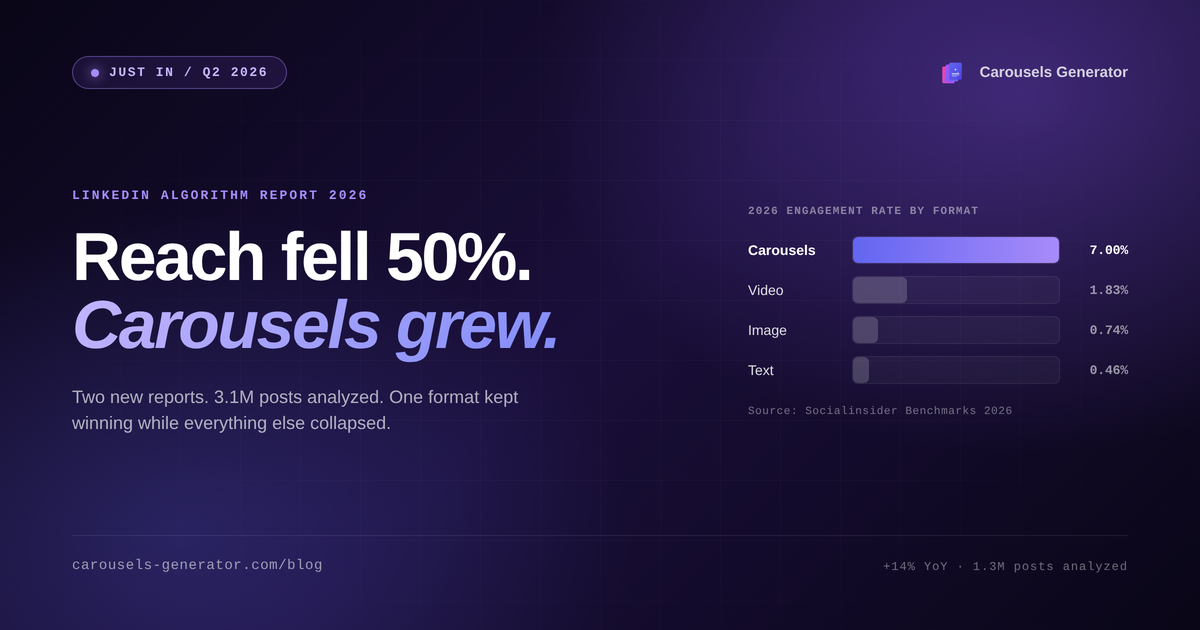
The Socialinsider 2026 report puts the average engagement rate on document carousels at 7.00%, a 14% jump year-over-year. The platform-wide rate sits at 5.20%. Carousels run roughly 35% above the LinkedIn baseline, and the gap keeps widening.
Compared with other formats, the distance is much larger. Postunreel measured carousels at 596% more engagement than text-only updates and 278% more than native video. Marketing4eCommerce reports 11x more interactions than static images, despite images being posted six times more often.
| Format | 2026 average engagement rate |
|---|---|
| Document carousels | 7.00% |
| Native video | 1.83% |
| Single image | 0.74% |
| Text-only post | 0.46% |
That table has now stayed in roughly the same shape for three consecutive years. Each new benchmarks report shows carousels at the top, with the lead growing rather than narrowing.
Why carousels keep winning while everything else declines
Richard van der Blom's report flags a brutal trend for everything that is not a carousel. Organic views on LinkedIn dropped 50% year-over-year. Follower growth fell 59%. Average post reach shrank from 15 to 20% of followers down to 8 to 12%. The platform is becoming harder to win on for almost every format.
Carousels survive that compression for one specific reason. They produce dwell time on demand.
When someone taps a carousel and starts swiping, every slide adds time on screen. The algorithm reads that as a strong vote of confidence and pushes the post into a wider audience. A static image cannot do this. A text post cannot do this. Video has to fight for watch time and lose most of it before anyone slows down. Carousels invite the action by design, and the design hasn't changed in two years even though the algorithm around it has.
The 2026 reports also confirmed two changes in how LinkedIn weights signals.
Saves and sends now outrank likes. A save tells the algorithm someone wants to come back to your post later. A send tells it the content was worth pushing into a private message. Both indicate value beyond a thumb-tap, and the new model treats them as primary signals.
The first 90 minutes decide everything. Early engagement during the first hour and a half determines whether your post gets promoted to second-degree connections or quietly buried. The 2024 version of the algorithm gave you roughly four hours of grace period. That window is now closed.
Carousels score well on both. They produce saves naturally because each slide can stand alone as a reference. They produce sends because a swipeable PDF is shareable in a way that a wall of text is not.
Ready to put this into practice?
Carousels Generator handles the text and design from a single prompt. Start with 10 free credits.
The shift: engagement bait is finally dead
For two years, the dominant carousel template was a hook slide promising a list, followed by eight slides of recycled platitudes. "10 ChatGPT prompts that will change your life." "Swipe to see the framework I used to scale to $1M." That era is over.
In Q1 2026, LinkedIn rolled out a series of distribution penalties for what it now classifies as low-substance content. Dataslayer tracked the impact across its client base:
- Posts ending with a "Follow me for more" sticker get throttled.
- Carousels recycling generic listicles without specific data lose an average of 35% reach.
- Repetitive comment-bait endings like "Agree?" or "Thoughts?" trigger reduced amplification.
The reward shifted toward depth. Richard van der Blom's data shows that one detailed post per week now outperforms five shallow posts. Posting frequency above three updates per week starts to dilute reach for most accounts, because your own posts cannibalize each other inside the algorithm.
What still works in Q2 2026:
- Specific case studies with numbers nobody else has published.
- Frameworks that walk through a real decision, not a generic concept.
- Honest documentation of mistakes and what they cost you.
What stopped working:
- Hook slides that do not deliver on what they promise.
- Generic "X lessons from Y" listicles.
- AI-generated text that pattern-matches to other AI posts.
A practical playbook for Q2 2026
The two reports converge on roughly the same advice. You do not need a redesign, you need tighter content discipline.
Cut your posting volume in half
If you publish five carousels a week, drop to two. The algorithm now distributes your strongest post wider when it is not competing with three weaker posts from your own profile. Trust Insights recommends two to three high-quality carousels per week as the new ceiling for reach efficiency.
Earn the swipe on slide one
The hook is no longer a template trick. It is a promise that the rest of the carousel has to keep. If slide one says "5 mistakes that cost me $40K," slides two through six each have to name one mistake with the actual cost attached. Vague hooks now correlate with measurable reach loss.
Keep slide count between 8 and 10
Socialinsider's data shows that 8 to 10 slides remains the sweet spot for completion rate. Below six, dwell time stays too low to trigger an algorithmic boost. Above twelve, completion falls off a cliff and the algorithm reads partial swipes as a weak signal.
Design for saves, not likes
A carousel that someone saves keeps getting distributed for weeks. Build at least one slide that works as a standalone reference: a checklist, a comparison table, a numbered framework. That slide is what gets screenshotted, saved, and shared in a DM. It does the heavy lifting on the algorithm side long after the post leaves the feed.
Stop using AI to write the text raw
This one matters. LinkedIn's classifier got noticeably better at flagging generic AI prose during Q1 2026, and posts that read as templated lose reach. Use AI to draft, then rewrite in your own voice with a specific story or number that only you have. The 2026 reports flag "human-edited AI content" as the highest-performing category, well above raw AI output.
How Carousels Generator fits the 2026 reality
The shift in the algorithm rewards exactly what we built the tool around. Speed without sacrificing specificity.
You give the AI a prompt that contains your real story, your numbers, your customer cases. The tool produces the design and structure in under 2 minutes. You spend the saved time on what matters most: rewriting two or three slides in your own voice, adding the data points that make the carousel genuinely useful, polishing the hook so it earns the rest of the swipes.
That is the 2026 workflow. Generate the scaffolding fast, then earn the saves with the parts only you can write.
The free plan includes 10 credits and works without a credit card. Build your first carousel in two minutes, then refine the slides that matter most. The algorithm will reward what you put in.
If you want to compare tools before signing up, the 2026 carousel generator comparison tests seven options across speed, AI quality, and pricing.
Sources
- Socialinsider, 2026 LinkedIn Benchmarks Report
- Richard van der Blom, Algorithm InSights 2025/2026
- Postunreel, LinkedIn Carousel Engagement Statistics 2026
- Dataslayer, LinkedIn Algorithm February 2026 Update
- Marketing4eCommerce, Carousels Dominate LinkedIn
Ready to create carousels like a pro?
Stop spending hours on each LinkedIn post. Let AI handle the text and design for you.
Popular LinkedIn carousel templates
Reuse in one click on your own topic. AI rewrites the text, keeps the design.